Mere Christian Liturgy?
How Eugen Rosenstock-Huessy Can Help Us Understand Christian Worship

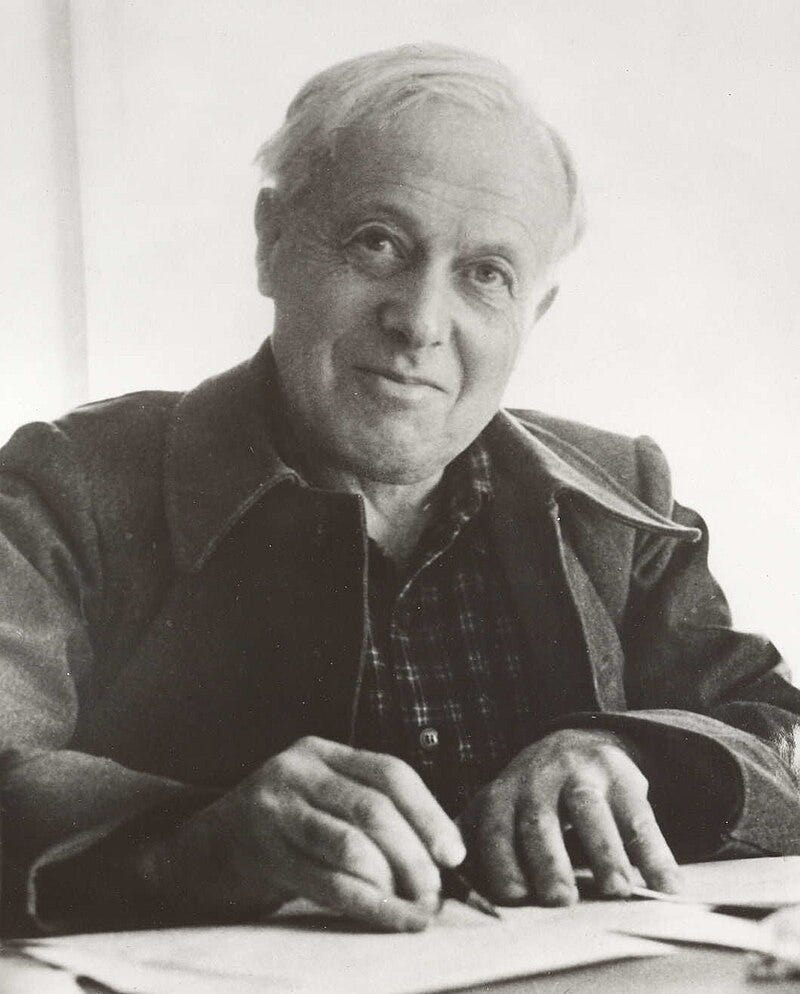
Eugen Rosenstock-Huessy was an historian and social philosopher, whose work spanned the disciplines of history, theology, sociology, linguistics and beyond. Born in Berlin, Germany into a non-observant Jewish family, the son of a prosperous banker, he converted to the Christian faith in his late teens. Thereafter, the interpretation and reinterpretation of the Christian way was a consistent theme in his writings.
Now, one of Rosenstock-Huessy’s central ideas is that, in a sense, speech creates reality—not just describes it. He saw language, especially imperatives and responses, as the fundamental building blocks of human community.
This has resonances in everything from Dr Spencer Klavan’s recent work on the physical sciences, to music and the arts, to liturgy.
“We speak so that we may be changed.”
(Out of Revolution)
Central to liturgy, then, is transformative speech—a dialogue between God and humanity. We might even say it is 'transfigural', to borrow from Dr Kevin Vanhoozer, whose work on Mere Christian Hermeneutics should inform any Mere Christian approach to liturgy.
Let’s follow Vanhoozer and C.S. Lewis in looking at what is common to different Christian traditions. Across each of them, liturgy features:
1. God’s Word (Scripture readings, proclamation)
2. Human response (confession, prayer, song)
3. Call-and-response forms (Kyrie, Psalms, Creeds)
This dialogical nature of liturgy unites Catholics, Protestants, and Orthodox. In an expressive-individualist age (C. Trueman), it is imperative to remember that we are creatures in communion. We Christians can agree that worship is not a private expression, but a public act that calls and forms a people to the living God of the Bible.
Liturgical Time as Historical Healing:
To return to Eugen Rosenstock-Huessy now for a moment: This great Christian thinker had a profound theology of time. In his work, he argued that modernity had fragmented time in a number of harmful ways. However, he did stop at lament and shows us that the Church—through its calendar—can heal this by reconnecting us to real history and sacred rhythms.
It is vital that we see that modernity's fragmentation of time - and what C.S. Lewis named 'chronological snobbery' - blinds us to reality itself. It not just an ideological conceit.
By following Huessy and focusing our attention on distinct Christian liturgies, we can bear more powerful witness in the ruins of modernity.
However, this is not a notion of liturgy set aside for one day, with nothing to say to the rest of the week. Liturgy is central to a Christian way of life.
We might understand liturgy in the more specific sense of worship on Sunday, but we might also understand our various rituals as ‘cultural liturgies’, which form us alongside providing us with information. This wider definition of liturgy can help us to wrestle with modernity as a people set apart.
In this wider sense, and as a supplement to the staple of Church, we can also commend Classical Christian education as a liturgy that we Christians can be very intentional about today. Schools that focus on our common heritage are formative, beyond the time set aside for the liturgy of the Lord's Day and are a vital element of what Dr David Fagerberg refers to as 'mundane liturgy'. There are other examples we might use, but education is an important one, which I hope highlights the point.
My friend, Dr Louis demonstrates in his stellar work, how Classical Christian education and wrestling with The Great Books can build a bridge across the ages and the play a supporting role in Christian edification. Dare I say, sanctification?
Dr Markos suggests:
"The search for glory, for home, for destiny, for salvation, for truth transcends distinctions of race, class, gender, age, and culture.
That does not mean that they shy away from conflicts between those who have power and those who do not; but it does mean that the external and internal conflicts that drive the heroes to their glory or ruin are not reduced to categories of political, social, economic, or sexual power.
The view of man in these epics is expansive rather than reductive, humanistic rather than mechanistic. The heroes are shaped and influenced by their milieu, but they are not determined by it."
Let’s compare and contrast our Christian vision and way of life with the dominant model of modernity once again. Rosenstock-Huessy reminds us that “Liturgical time is not cyclical like pagan time, nor progressive like modern time. It is redemptive.”
C.S. Lewis used the phrase "mere Christian" to describe a person who adheres to the core beliefs of Christianity that are shared across all major Christian denominations, regardless of their theological or liturgical differences. He emphasized common ground—the essential doctrines of the Christian faith that unite believers, such as belief in God, the Trinity, Jesus Christ as the Son of God, His death and resurrection, and the promise of eternal life.
In his book, Mere Christianity, Lewis says: “I hope no reader will suppose that 'mere' Christianity is here put forward as an alternative to the creeds of the existing communions—as if a man could adopt it in preference to Congregationalism or Greek Orthodoxy or anything else. It is more like a hall out of which doors open into several rooms.”
I would suggest we approach Christian liturgy in the same spirit. A 'Mere Christian' approach to liturgy would draw from Eugen Rosenstock-Huessy’s insight by focusing on at least two key elements:
1. The church year (Advent, Easter, Pentecost) as shared memory of Christ’s life.
2. Worship as participation in redeemed time, where past, present, and future converge (e.g., “Christ has died, Christ is risen, Christ will come again”).
This applies across all traditions that keep even parts of the Christian liturgical calendar. Regardless of denomination, Eugen's heuristic, 'The Cross of Reality' can help us to understand Liturgical Structure and to live it out.
This describes human existence stretched in four dimensions:
Past ↔ Future (memory and hope)
Inner ↔ Outer (individual and society)
Vitally, liturgy embodies all four:
Past: Remembering salvation history.
Future: Anticipating Christ’s return.
Inner: Personal repentance and renewal.
Outer: Corporate expression and mission.
This framework can play a helpful role in building a theology of worship that is formative and unites Christian traditions around shared structure rather than just doctrinal uniformity. I think this is a key part of how we might bear witness to God’s presence in the world today.